

By Abigail Kyeremah Owusu
The Mortuaries and Funeral Facilities Agency (MoFFA) has appealed for additional staff to strengthen its nationwide monitoring of mortuary facilities. Challenges with the availability of personnel, concerns about overcrowding in mortuaries, coupled with challenges with occupational standards and safety, as well as the professional competence of mortuary attendants was pivotal in discussions regarding the Agency at the Public Accounts Committee hearing today Friday October 9, 2026
During consideration of the Auditor-General’s Performance Audit Report on the management of mortuary facilities in public hospitals, the Acting Deputy Registrar of the Mortuaries and Funeral Facilities Agency, Dr. Philip Sarpong said the Agency currently has about 22 staff responsible for regulating more than 200 mortuary facilities across the country, making it difficult to effectively monitor compliance with operational standards.

Dr. Sarpong said the Agency is working to decentralise its operations by establishing offices in the regions, with support from the Ghana Health Service and the Health Facilities Regulatory Agency.
“We need additional staff. Let me say that,” he told the Committee, adding that the Agency required at least 20 more personnel to support its regional operations.
The appeal for additional personnel followed concerns raised by Committee members about the need for effective supervision of mortuary facilities, the safety of mortuary attendants and provision of appropriate personal protective equipment (PPE).
Dr. Sarpong said the Agency had established occupational health and safety protocols that facilities were required to follow before being licensed. He explained that the requirements include vaccination records, evidence of health and safety training, policies on post-exposure prophylaxis, staff health records, reports on work-related injuries and appropriate waste disposal procedures. The prescribed protective equipment for mortuary attendants includes face masks, overalls, gloves, caps and boots.
According to Dr. Sarpong, the Agency conducts monthly unannounced and unscheduled compliance visits to ensure that licensed facilities continue to meet the required standards. He, however, acknowledged the challenge in monitoring a large number of mortuary facilities with the Agency’s existing staff strength.
On the training of mortuary attendants, he disclosed that about 176 attendants had graduated from training programmes this year as part of efforts to improve professional standards and the quality of mortuary services.
The Agency has collaborated with universities to develop a curriculum for the training programmes, which include an eight-week course offered by some institutions. According to Dr. Sarpong, attendants who complete the programmes receive certificates and are professionally licensed to operate, adding that, the training has resulted in improvements in compliance with operational protocols and standards at some facilities visited by the Agency.
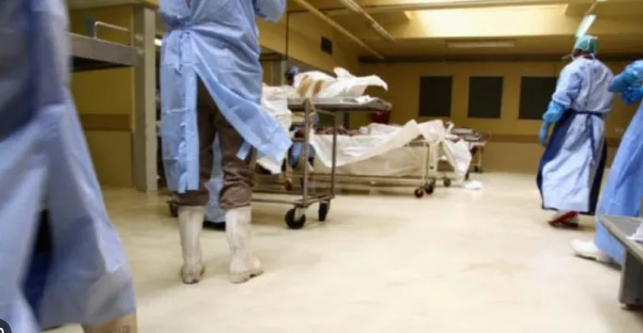
Dr. Sarpong initially said there was no specific basic qualification for the role, although he indicated that a Junior High School certificate was expected for some duties.
Committee members stressed the need for minimum competency standards to prevent errors such as incorrect identification and tagging of bodies, unauthorised releases and poor record-keeping. They warned that such mistakes could cause significant distress to bereaved families or have implications for disease control and called for stronger systems to ensure that bodies are correctly identified labelled and handled.

























































