By Nana Karikari, Senior Global Affairs Correspondent
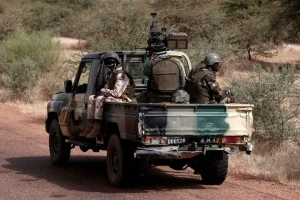
Militant groups launched a massive and coordinated series of attacks across Mali on Saturday morning. The assault targeted the capital city of Bamako and several strategic locations in the country’s interior. Mali’s army confirmed that “fighting is ongoing” as the military attempts to contain the violence. In an official statement, the military said unidentified “terrorist” groups had attacked several positions in the capital and elsewhere in the country without specifying the locations.
The army added that “our defence and security forces are currently engaged in repelling the attackers,” while urging the national population to remain calm.
The violence began shortly before 6 a.m. with explosions and heavy gunfire. Witnesses reported sustained combat near the Kati military base. This installation sits just outside Bamako and serves as the residence of military ruler General Assimi Goita. Two loud explosions preceded the gunfire, and soldiers quickly deployed to block roads throughout the area.
Capital Under Siege Near International Airport
The conflict reached the outskirts of Bamako near Modibo Keita International Airport. Gunfire was also heard near the international airport, specifically originating from a military camp that secures the facility. This camp is known to house Russian mercenary forces. Witnesses confirmed seeing a helicopter patrolling nearby neighborhoods as the sounds of battle intensified.
Travel has been severely disrupted by the unrest. One resident traveling from Ethiopia reported that all flights into Bamako were canceled early Saturday. The U.S. Embassy in Mali issued an emergency advisory for citizens to shelter in place. The embassy cited reports of explosions and gunfire near both the airport and the Kati base.
Attacks Spread Across Northern and Central Regions
The coordination extended far beyond the capital. Similar unrest occurred simultaneously in the central town of Sevare and the northern city of Gao. Residents in Gao reported that the force of explosions caused doors and windows to shake. One witness in Sevare described the chaos simply, stating “There’s gunfire everywhere.”
In the northeastern city of Kidal, gunmen reportedly entered and took control of several neighborhoods. Mohamed Elmaouloud Ramadane, a spokesperson for the Azawad Liberation Front (FLA), claimed on social media that his forces had “taken control of multiple positions in Kidal and Gao.” While these claims remain unverified, they underscore the scale of the challenge facing the central government.
Attribution and the Role of Armed Factions
As of Saturday afternoon, no group has officially claimed responsibility for the coordinated attacks. However, security sources suggest the involvement of the al-Qaeda affiliate Jama’at Nusrat al-Islam wal-Muslimin (JNIM). Mali faces a complex security landscape involving Islamic State in the Sahel Province (ISSP) and Tuareg-dominated rebel alliances.
The country has struggled with a security crisis since 2012. This crisis began with a separatist rebellion in the north that was later hijacked by Islamist militants. Despite the junta’s promises to restore security after seizing power in 2020, jihadist insurgencies continue to stage frequent attacks. Large portions of the north and east remain outside of government control.
Shift in Security Alliances and Geopolitics
Mali’s military government has significantly altered its international partnerships. After two coups in 2020 and 2021, Bamako severed ties with France and expelled United Nations peacekeepers. The junta pivoted toward Russia for support, initially hiring the Wagner Group. That organization has since transitioned into the Africa Corps under the direct control of the Russian Ministry of Defence.
In July last year, military authorities granted Goita a five-year presidential mandate, which can be renewed “as many times as necessary” without an election. Regional dynamics have also shifted with the formation of the Alliance of Sahel States (AES). While the government has leaned heavily on Russian support, it has recently pursued closer ties with the United States. Reports indicate the two nations are nearing a deal to allow U.S. intelligence-gathering flights over Malian airspace.
As the situation on the ground remains fluid, the scale of this synchronized offensive suggests both a significant intelligence gap and a sophisticated level of planning that directly challenges the junta’s primary mandate of domestic stabilization. While the military continues its efforts to “repel the attackers,” the lack of an immediate claim of responsibility adds a layer of profound uncertainty to an already volatile transition toward promised security.