By Nana Karikari, Senior Global Affairs Correspondent
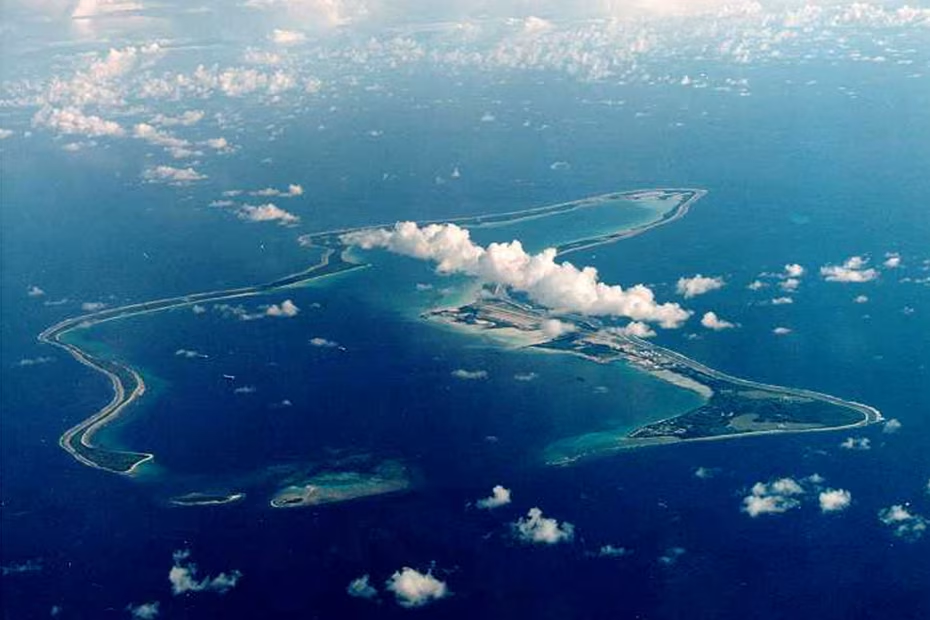
The United Kingdom confirmed Saturday that Iran launched an unsuccessful missile attack against the joint U.S.-U.K. military base at Diego Garcia. The Ministry of Defence (MoD) disclosed that the strike occurred shortly before London authorized expanded American use of British bases for operations in the Middle East.
Failed Strike on Strategic Outpost
Iran fired two intermediate-range ballistic missiles at the installation located in the Chagos Islands. One missile suffered a mechanical failure during flight, while the other was engaged by a U.S. warship utilizing an SM-3 interceptor. Officials have not confirmed if the interception was successful, but the MoD stated the facility was not hit.
The attack represents a significant escalation in Tehran’s reach. It marks the first operational use of intermediate-range ballistic missiles by Iran in an attempt to strike targets far beyond the Middle East. Diego Garcia sits approximately 2,360 miles from Iran and serves as a vital hub for long-range U.S. bombers and maritime logistics.
Washington Rejects Ceasefire Proposals
U.S. President Donald Trump has repeatedly criticized the U.K.’s strategic pace, previously remarking on March 3, “This is not Winston Churchill that we’re dealing with.” Speaking from the White House South Lawn before departing for Florida on Friday, the President dismissed the possibility of a truce with Tehran. “We could have dialogue, but I don’t want to do a ceasefire,” Trump said. “You know you don’t do a ceasefire when you’re literally obliterating the other side.”
Trump also escalated his rhetoric against other international partners, calling NATO allies “cowards” for their perceived refusal to assist in reopening the Strait of Hormuz. The President characterized the Iranian military as severely depleted, asserting, “They don’t have a navy. They don’t have an air force. They don’t have any equipment.” Despite the ongoing strikes, Trump claimed in a Truth Social post later Friday afternoon that the U.S. is “getting very close to meeting our objectives as we consider winding down our great Military efforts in the Middle East.”
Shifting Policy and Strategic Ambiguity
While critics have labeled the move a reversal, the U.K. government framed the loosening of restrictions as consistent with its established stance. “The principles behind the UK’s approach to the conflict remain the same: the UK remains committed to defending our people, our interests and our allies, acting in accordance with international law and not getting drawn into the wider conflict,” the U.K. government said in a statement.
Prime Minister Keir Starmer has so far walked a diplomatic tightrope on Iran, balancing relations with the Trump administration and protecting U.K. assets in the Mediterranean while avoiding direct participation in a war that polling shows is overwhelmingly unpopular with the British public. However, the new authorization for the U.S. to target assets “targeting the Strait of Hormuz” remains operationally vague and could hypothetically permit strikes against a broad range of Iranian missile and drone infrastructure.
The Chagos Archipelago and Sovereignty Disputes
The Chagos Islands, which house the base, have been the subject of a long-standing rift. Mauritius, an Indian Ocean nation and a close ally of China, has argued it was illegally forced to cede the archipelago to gain independence from Britain. In 2019, the International Court of Justice declared the British occupation unlawful. In response, the U.K. agreed in May 2025 to transfer sovereignty to Mauritius, under a deal where the U.K. and U.S. retain a 99-year lease of the base. President Trump has vacillated on the deal, urging Starmer in February not to “give away Diego Garcia,” despite Washington offering official backing just days prior.
Iranian Warnings and Retaliation Threats
Tehran has reacted with hostility to the increased cooperation between London and Washington. Foreign Minister Abbas Araghchi accused the British government of ignoring its own citizens. “Vast majority of the British People do not want any part in the Israel-U.S. war of choice on Iran,” Araghchi posted on X.
The Foreign Minister warned that the use of British territory for American strikes would lead to direct consequences. “Ignoring his own People, Mr. Starmer is putting British lives in danger by allowing UK bases to be used for aggression against Iran. Iran will exercise its right to self-defense,” Araghchi said.
Domestic Opposition and Regional Risks
The security crisis coincides with the U.K.’s May 2025 agreement to transfer sovereignty of the Chagos Islands to Mauritius. Under the deal, the U.K. will lease back the Diego Garcia base. This arrangement has faced criticism from President Trump and domestic political opponents in London.
Conservative leader Kemi Badenoch labeled the Prime Minister’s shift in military policy as the “mother of all U-turns.” The risks were underscored by a previous Iranian drone strike on RAF Akrotiri in Cyprus following a similar defensive authorization. Consequently, the Liberal Democrats and the Green Party have demanded a parliamentary vote before further permissions are granted to the United States.
International Efforts and Economic Impact
The U.K. is now coordinating with France, Germany, Japan, Italy, and the Netherlands to secure the Strait of Hormuz. In a joint statement, these nations expressed “readiness to contribute to appropriate efforts to ensure safe passage through the Strait.” London has deployed a record number of aircraft to the region, with pilots exceeding 700 flight hours.
The domestic fallout of the conflict remains a priority for Downing Street. Prime Minister Starmer is expected to hold a Cobra meeting next week to discuss plans to help households with the cost of living caused by the war. While the RAF has not yet engaged in offensive strikes, the MoD confirmed it has sent “a small number of additional planners” to U.S. Central Command to “improve security” in the vital waterway.
A High-Stakes Geopolitical Balance
The targeting of Diego Garcia marks a definitive shift in the geography of the conflict, forcing London to balance its “special relationship” with Washington against the rising physical and economic risks to the British Isles. By expanding U.S. access to RAF bases, the Starmer administration has prioritized the restoration of global maritime trade
over de-escalation. However, as Iran demonstrates its ability to strike thousands of miles from its borders and domestic pressure mounts over the cost of living, the U.K. faces a narrowing path to remain a “lukewarm” participant. The coming weeks will determine if this assertive stance successfully deters Iranian aggression or draws London deeper into a conflict it has spent months trying to contain.