
An Investigative Exposé for Ghana and Africa
By David Gyedu (DK Cyber)
Director of Cybersecurity, Cyber1defense Communication Limited

Special Investigation into Digital Surveillance in Africa
THE UNCOMFORTABLE TRUTH
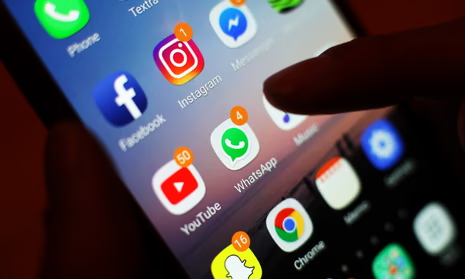
Every time you pick up your smartphone, open a social media app, search on Google, or simply browse the internet, you are being watched. Not by human eyes, but by sophisticated surveillance systems more powerful than anything the Stasi, KGB, or any intelligence agency in history ever possessed. And the shocking reality? Most Africans have no idea it’s happening.
This investigation will expose the invisible surveillance empire that has turned every device you own into an informant, every app into a spy, and every click into evidence against you. What you’re about to discover will fundamentally change how you view your digital life.
PART 1: THE SURVEILLANCE STATE YOU DIDN’T KNOW EXISTED
The African Reality: Ghana’s $184 Million Surveillance Investment
While Ghanaians debate about economic hardship, few realize that the government has quietly spent $184 million acquiring mass surveillance technologies from overseas companies. According to 2024 report by the UK-based Institute of Development Studies (IDS), published in April 2024 and covered extensively by Ghana Business News, Ghana now possesses:
- Pegasus spyware from NSO Group (Israel) – capable of turning any smartphone into a complete surveillance device
- UFED spyware from Cellebrite (Israel) – donated by UK, US government, and Interpol for mobile device forensics
- Huawei ‘Safe Cities’ technology (China) – facial recognition and number plate tracking systems
- Multiple biometric identification systems requiring citizens to provide facial recognition and fingerprints
Despite Ghana being recognized as Africa’s most dynamic democracy with a Global Cybersecurity Index score of 99.27% in 2024, the rapid expansion of surveillance infrastructure has raised alarm bells. The technology meant to protect citizens is increasingly used to monitor, track, and silence opposing voices.
The Continental Pattern: Africa’s Surveillance Boom
Ghana is not alone. Across Africa, governments have partnered with foreign surveillance technology companies with minimal oversight:
- Zimbabwe: Surveillance technology used to intimidate opposition groups and activists
- Ethiopia: Digital monitoring reportedly targets ethnic minorities during civil unrest
- Rwanda: Widespread internet surveillance discourages activism and citizen engagement
- Kenya, Nigeria, Uganda, Tanzania, Mozambique: Biometric ID linked to SIM cards, creating comprehensive tracking databases
Unlike Europe’s GDPR or South Africa’s POPIA, most African nations lack robust legal safeguards to protect citizens’ data. With over 15 million internet users in Ghana alone, and nearly 400 million social media users across Africa, the amount of personal data vulnerable to exploitation is staggering.
PART 2: HOW THEY SPY ON YOU – THE TECHNICAL ARSENAL
The Seven Pillars of Digital Surveillance
1. YOUR INTERNET SERVICE PROVIDER: The First Betrayer
Your ISP sees EVERYTHING you do online:
What They Track:
- Every website you visit (complete URLs and timestamps)
- All your search queries on Google, YouTube, Facebook
- How long you spend on each website
- Your real-time location via cell tower triangulation
- All unencrypted data you send (passwords, messages, financial info)
- Which services you use for torrenting or P2P networks (they throttle your bandwidth)
What They Do With It:
- Sell your data to advertisers and marketing companies
- Share with intelligence agencies and law enforcement (often without warrants)
- Monitor for government surveillance programs
- Build comprehensive profiles of your online behavior
2. SOCIAL MEDIA: The Confession Booth
Facebook, Instagram, WhatsApp, Twitter, TikTok – these platforms know more about you than your spouse:
The Data They Collect:
- Your location history (even when you think location is off)
- Every message you send, even ‘deleted’ ones (they’re never truly deleted from servers)
- Your contacts, phone numbers, call logs
- Photos with embedded GPS data showing exactly where each photo was taken
- Voice recordings from voice messages and video calls
- Your relationship status, political views, religious beliefs, health information
- How long you look at each post (engagement metrics)
- Your typing patterns and when you delete messages before sending
The Shocking Truth: According to recent reports, US law enforcement requests to Amazon increased by 264%. A Fitbit’s heart rate data was used as evidence in a murder charge. Your social media confessions are digital evidence.
African Context: In 2024, the US government gained direct access to tech company databases under the updated FISA law. African governments can request this data for their citizens, often without judicial oversight. The Cambridge Analytica scandal exposed how easily this data is weaponized for political manipulation.
3. BROWSER FINGERPRINTING: Your Device’s Unique DNA
This is the most sophisticated and invisible tracking method. Even if you delete all cookies, use private browsing, and clear your history, websites can still identify you with 89.4% accuracy using browser fingerprinting.
How It Works – The Technical Details:
Canvas Fingerprinting: Websites force your browser to draw an invisible image. The way your specific graphics card, operating system, browser, and font settings render that image creates a unique identifier. Every device renders it slightly differently – like a digital fingerprint.
What They Detect:
- Your exact screen resolution and color depth
- All installed fonts on your device
- Your browser version and all installed plugins/extensions
- Your graphics card model and driver version
- Your CPU specifications (including whether you use AES-NI or Intel Turbo Boost)
- Your battery status (yes, they track how charged your battery is!)
- Your timezone, language settings, and keyboard layout
- Whether you have ad blockers or privacy tools installed
- Your audio and video device capabilities
The Reality: Studies show 10% of the top 100,000 websites use canvas fingerprinting. When combined with other fingerprinting techniques (WebGL, audio, font detection), they create a fingerprint that follows you across the entire web – even when you use VPNs or private browsing.
4. HIDDEN TRACKING APPS: The Invisible Spies in Your Pocket
There’s a booming industry of spy apps that can be installed on smartphones without the user’s knowledge. These apps operate in complete stealth mode:
Popular Tracking Apps (Available Commercially):
- mSpy: 1.5 million users worldwide, completely invisible on target phones
- Hoverwatch: Works on Android, Windows, and macOS – completely hidden with no icons or alerts
- KidsGuard Pro: Tracks phone without user knowledge, even works when GPS is off
- Snoopza: Free spy app that operates in 100% stealth mode
- FlexiSPY: Offers remote camera access and live call recording
What These Apps Can Do:
- Read all your WhatsApp, Facebook, Instagram, Snapchat, Telegram messages
- Track your real-time GPS location and location history
- Record all incoming and outgoing phone calls
- Capture screenshots of your phone screen every few minutes
- Log every keystroke you type (including passwords)
- Access your camera and microphone remotely
- View all photos and videos on your device
- Track which apps you use and for how long
- Continue tracking even if you remove the SIM card
The African Angle: These apps are marketed as ‘parental control’ or ’employee monitoring’ tools, but they’re widely used by suspicious partners, criminals, and even governments for surveillance. In Ghana and across Africa, many people’s phones have these apps without their knowledge.
5. GOVERNMENT SURVEILLANCE: The State is Watching
Government surveillance operates on multiple levels:
US Government (Affecting Africans Using US Tech):
- NSA mass surveillance programs monitor global internet traffic
- FISA Act (updated April 2024) allows data sharing from Google, Facebook, Amazon
- Department of Homeland Security monitors social media using keyword lists (ranging from ‘attack’ to ‘public health’ to ‘jihad’)
- Communications Assistance for Law Enforcement Act ensures all telecom traffic can be monitored
African Government Surveillance:
- Stingray devices: Fake cell towers that intercept all nearby mobile communications
- Internet traffic interception under ‘national security’ provisions
- Social media monitoring tracking keywords and influencers
- Biometric databases linking faces, fingerprints to online activity
- Partnership with foreign surveillance companies (China, Israel, US)
Case Study: In Ghana, the Data Protection Commission arrested representatives from five organizations in September 2023 for violations. However, government surveillance itself operates largely unregulated.
6. GOOGLE: The All-Seeing Eye
Google is not just a search engine – it’s the world’s largest surveillance apparatus:
What Google Knows About You:
- Every search query you’ve ever made (saved permanently)
- Your complete location history via Google Maps (down to specific buildings)
- All YouTube videos you’ve watched (including those you watched while logged out)
- Your emails, calendar, contacts, photos (if using Gmail/Google Photos)
- Your voice recordings from Google Assistant
- Everywhere you’ve ever traveled (Google Timeline)
- Your health searches, financial queries, relationship problems
Google Chrome Tracking: Chrome in particular is notorious for allowing websites to track you. It collects:
- Your browsing history across all devices
- Your passwords (if using Chrome password manager)
- Your autofill information (addresses, payment methods)
- Synced data from all your devices
The Advertising Network: Google operates millions of websites through its advertising network. When you visit ANY website with Google Ads, Google drops a cookie and tracks you across the entire internet. They build comprehensive profiles showing your interests, shopping habits, income level, education, and even predict your future behavior.
7. COOKIES AND TRACKING PIXELS: The Silent Stalkers
Traditional Cookies: Small text files websites store on your browser. While some are necessary (like keeping you logged in), third-party cookies track you across websites. Google and Facebook use these to follow you everywhere.
Super Cookies (The Dangerous Evolution):
- Adobe Local Shared Objects – cannot be deleted through normal browser clearing
- Microsoft User Data Persistence – embedded in Windows
- HTML5 Local Storage – stores 10MB+ of data that persists across sessions
Tracking Pixels: Invisible 1×1 pixel images embedded in emails and websites. When loaded, they:
- Confirm you opened an email and when
- Track your IP address and location
- Monitor which device you’re using
- Record how long you spend reading content
PART 3: REAL-WORLD EXAMPLES – WHEN SURVEILLANCE BECOMES EVIDENCE
Example 1: The Fitbit Murder Case
A woman claimed her husband died during consensual rough sex. Investigators accessed her Fitbit data, which showed her heart rate remained calm during the alleged incident – proving she was lying. She was charged with murder based on her wearable device data.
Lesson: Your fitness trackers, smartwatches, and health apps are collecting evidence about your daily activities that can be used against you in court.
Example 2: The Facebook Detective
A teenager posted about wanting to travel from Accra to Europe for better opportunities. Within weeks, his Facebook messages were accessed by immigration authorities. His posts showing association with certain groups led to increased scrutiny. His ‘private’ messages discussing plans were used to deny his visa application.
Lesson: Nothing on social media is truly private. Even direct messages can be accessed and used against you.
Example 3: The Search History Nightmare
A Lagos businessman searched Google for ‘chest pain’ and ‘heart problems’ while considering which insurance policy to buy. Months later, his health insurance premiums were increased significantly. Data brokers had sold his search history to insurance companies, who classified him as ‘high risk.’
Lesson: Your search queries are permanent records that data brokers sell to companies that use them to make decisions affecting your life.
Example 4: The Location Tracking Betrayal
A journalist in Zimbabwe investigating government corruption thought he was safe because he used encrypted messaging. However, his phone’s location history revealed he had visited the homes of opposition leaders. He was arrested based solely on his location data from Google Maps, which he didn’t realize was being recorded.
Lesson: Even with encrypted communications, your location data reveals who you meet, where you go, and what you do.
Example 5: The WhatsApp Trap
An Accra resident ‘deleted’ compromising WhatsApp messages from a group chat. Months later, during a legal dispute, those ‘deleted’ messages were retrieved from Meta’s servers and used as evidence in court. WhatsApp’s end-to-end encryption only protects messages in transit – once delivered, they’re stored unencrypted on servers and can be accessed with legal requests.
Lesson: Deleted messages are never truly deleted from company servers. They can be retrieved and used as evidence.
PART 4: THE HIDDEN SURVEILLANCE ECONOMY
The Data Broker Industry: Selling Your Life
There’s a multi-billion dollar industry you’ve never heard of: data brokers. These companies:
- Buy your data from ISPs, social media companies, and websites
- Combine it with offline data (public records, loyalty cards, credit cards)
- Create comprehensive profiles worth $0.50 to $2 per person
- Sell these profiles to:
- Insurance companies (who use them to raise your premiums)
- Employers (who screen job applicants)
- Advertisers (who target you with precision)
- Law enforcement (who buy access without warrants)
- Governments (for surveillance purposes)
- Scammers and criminals (who use them for identity theft)
What’s in Your Profile:
Your complete profile can contain over 5,000 data points including:
- Your health conditions and medical searches
- Financial status and creditworthiness
- Political affiliations and voting likelihood
- Religious beliefs and practices
- Relationship status and sexual orientation
- Shopping habits and income estimation
- Education level and career history
- Personality traits and psychological profile
- Social connections and influencer potential
- Daily routines and behavioral patterns
How It Works: The Tracking Ecosystem
Every website you visit has an invisible network of trackers:
- You visit a news website in Ghana
- That site loads 50+ third-party trackers (Google Analytics, Facebook Pixel, advertising networks)
- Each tracker reports your visit to dozens of companies
- Those companies share data with their partners
- Before you leave the page, 200+ companies know you were there
You interact with one website, but your data flows to hundreds of vendors. Each click multiplies your exposure. In 2025, tracking technologies operate in milliseconds, creating real-time profiles as you browse.
PART 5: HOW TO PROTECT YOURSELF – A COMPREHENSIVE DEFENSE STRATEGY
The reality is grim, but you’re not powerless. Here’s your complete defense strategy:
LEVEL 1: Basic Protection (Everyone Should Do This)
1. Use a VPN (Virtual Private Network)
- Encrypts all your internet traffic so ISPs can’t see what you do
- Hides your real IP address and location
- Recommended: NordVPN, ExpressVPN, ProtonVPN (which has a free tier)
- Cost: $3-12/month – Worth it for your privacy
- African Option: Look for VPN servers in Ghana or neighboring countries for better speeds
2. Switch Your Browser to Firefox or Brave
- Google Chrome is the worst for privacy – it tracks everything
- Firefox has built-in Enhanced Tracking Protection (enabled by default since 2019)
- Brave blocks ads and trackers automatically and uses randomization to fight fingerprinting
- Microsoft Edge is the MOST fingerprintable browser – avoid it
3. Install Privacy Extensions
- Privacy Badger (by EFF) – Automatically blocks trackers
- uBlock Origin – Blocks ads and tracking scripts
- HTTPS Everywhere – Forces encrypted connections
- NoScript – Blocks JavaScript (advanced users only, as it breaks many websites)
4. Change Your Search Engine
- DuckDuckGo – Doesn’t track your searches or create profiles
- Startpage – Uses Google results but without the tracking
- Brave Search – Privacy-focused with its own search index
5. Secure Your Phone
Check for spy apps: Look for battery draining quickly, phone heating up, strange sounds during calls, data usage spikes
- On Android: Download ‘TrackerControl’ app – it reveals which apps are tracking you and blocks them
- Turn off location services for apps that don’t need it
- Disable ‘Google Location History’ and ‘Web & App Activity’ in Google settings
- Use Signal instead of WhatsApp for truly private messaging
6. Clean Your Digital Footprint
- Delete old social media accounts you don’t use
- Request data deletion from Google (myaccount.google.com/data-and-privacy)
- Remove yourself from data broker sites (use services like ClearNym or DeleteMe)
- Clear your browser cookies and cache regularly
LEVEL 2: Advanced Protection (For High-Risk Individuals)
7. Use Tor Browser for Anonymous Browsing
- Routes traffic through multiple servers worldwide
- Makes every user’s fingerprint identical (anonymity through uniformity)
- Downside: Very slow speeds
- Recommended for: Journalists, activists, whistleblowers
8. Use Tails OS for Maximum Anonymity
- Operating system that runs from a USB stick
- Leaves no trace on the computer you use
- Routes all connections through Tor automatically
- Used by Edward Snowden and investigative journalists
9. Compartmentalize Your Digital Life
- Use different email addresses for different purposes (work, personal, shopping, throwaway)
- Create separate user profiles or use virtual machines for sensitive work
- Never link your real identity to privacy-focused accounts
- Use ProtonMail or Tutanota for encrypted email
10. Mobile Phone Security Hardening
- Use GrapheneOS or LineageOS (privacy-focused Android alternatives)
- Disable all Google services
- Use F-Droid app store instead of Google Play
- Enable encryption on your device
- Use a strong PIN/password, not biometrics (fingerprints can be compelled by law)
LEVEL 3: Extreme Protection (For Those Under Active Surveillance)
11. Air-Gapped Computing
- Keep one computer completely disconnected from the internet for sensitive work
- Transfer files only via encrypted USB drives
- Used by security researchers and high-value targets
12. Physical Security Measures
- Cover your webcam with tape or a webcam cover
- Never leave devices unattended where spy software could be installed
- Use Faraday bags to block all signals when traveling with sensitive devices
- Consider a separate ‘burner’ phone for sensitive communications
13. Counter-Surveillance Awareness
- Assume anything digital can be compromised
- Have truly sensitive conversations face-to-face, outdoors, without phones
- Use code words and never discuss sensitive topics directly on any platform
- Regularly factory reset devices to remove potential spyware
PART 6: THE AFRICAN CONTEXT – SPECIAL CONSIDERATIONS
Data Protection Laws in Africa: Strong on Paper, Weak in Practice
Ghana’s Data Protection Act (2012): Ghana has relatively strong data protection laws, but enforcement is inconsistent. The Data Protection Commission has arrested violators, but government surveillance operates largely unchecked.
Continental Progress:
- 36 of 54 African countries have data protection laws (as of 2024)
- Kenya, South Africa, Nigeria leading in enforcement
- Many countries lack independent oversight bodies
- Government surveillance exemptions common
The Biometric ID Threat
Across Africa, governments are linking biometric IDs (fingerprints, facial recognition) to SIM cards and national databases. This creates comprehensive tracking systems where:
- Your face is matched to all your online activity
- Your phone number is permanently linked to your identity
- Facial recognition cameras track your movements in public
- Complete digital profiles are created without consent
Countries implementing this: Ghana, Kenya, Nigeria, Uganda, Tanzania, Mozambique, Zimbabwe
The Mobile Money Surveillance
Mobile money (MTN Mobile Money, Vodafone Cash, AirtelTigo Money) is ubiquitous in Africa. Every transaction creates a permanent record showing:
- Who you send money to and receive from
- When and where transactions occur
- Your spending patterns and financial relationships
- Your complete financial network
This data is accessible to telecom companies, banks, and governments – often without robust privacy protections.
Internet Shutdowns: The Ultimate Surveillance Tool
African governments have increasingly used internet shutdowns during elections and protests. While framed as security measures, they serve surveillance purposes:
- Force people onto monitored communication channels
- Allow targeted surveillance of VPN users (who stand out during shutdowns)
- Create chilling effects on free expression
CONCLUSION: THE CHOICE IS YOURS
We stand at a crossroads. The digital surveillance infrastructure is already built. The data is already being collected. The question is not whether you are being watched – you are. The question is what you will do about it.
For Ghana and Africa, the stakes are particularly high. As young democracies, we cannot afford to normalize surveillance states. History teaches us that surveillance powers granted for ‘security’ are eventually used for political control.
The tools to protect yourself exist. Use them. The awareness to recognize surveillance is now yours. Share it. The power to demand better privacy laws lies with citizens. Exercise it.
Your privacy is not dead – but it requires active defense. Every step you take toward privacy protection is a step toward freedom.
The internet knows your secrets. Now you know its secrets. The invisible informant has been exposed.
What you do next is up to you.
TAKE ACTION TODAY:
- Share this article with every Ghanaian and African you know
- Install at least 3 privacy tools TODAY (VPN, Privacy Badger, Firefox)
- Check your Google and Facebook privacy settings RIGHT NOW
- Demand transparency from your government about surveillance programs
- Support organizations fighting for digital rights in Africa
“As Director at Cyber1defense Communication Limited, I lead operations across African countries, specializing in ethical hacking, penetration testing, digital forensics investigation, financial fraud intelligence, threat intelligence, and OSINT operations. But my work transcends titles—I’m an architect of defense systems, an investigator who follows money through the darkest digital corridors, a developer who builds tools when commercial solutions fall short, and a mentor training the next generation of African cyber defenders”- David Gyedu


