
By Nana Karikari, Senior Global Affairs Correspondent
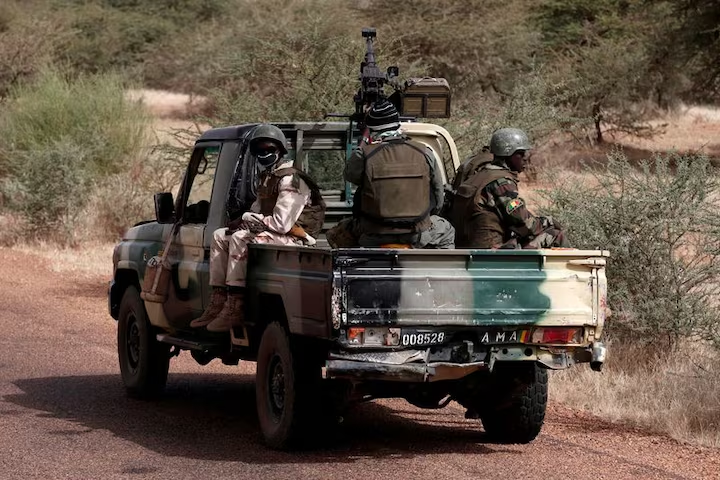
Russian Africa Corps mercenaries and Malian government troops have begun a strategic withdrawal from the city of Kidal. This move follows two days of intense combat against separatist forces. The Azawad Liberation Front (FLA) now claims full administrative control of the northern city. The withdrawal was facilitated by a formal negotiation between the opposing factions.
Mohamed Elmaouloud Ramadane, a spokesperson for the FLA, confirmed the shift in power on Sunday. “An agreement was reached between the Azawad forces and the Russian elements of the Africa Corps with a view to ensuring their secure withdrawal from the fighting,” Ramadane stated. He later declared the city’s status via social media. “Kidal is declared free,” he said. Witnesses confirmed Russian mercenaries were heavily involved in fighting around their Bamako airport headquarters before the shift to the north. Reports indicate the FLA had explicitly asked the Russians to surrender their weapons before “stepping out” of Kidal, a move analysts describe as a significant blow to their local reputation.
Unprecedented Coordination Among Armed Groups
The loss of Kidal serves as a significant setback for the ruling military junta. Government forces had captured the city in late 2023 with heavy Russian assistance. This weekend’s escalation marks a new level of cooperation between disparate militant groups. The Tuareg-led separatists worked in tandem with the al-Qaeda-linked Jama’at Nusrat al-Islam wal-Muslimin (JNIM).
Ramadane emphasized this new alliance in his remarks to the press. “This operation is being carried out in partnership with the JNIM, which is also committed to defending the people against the military regime in Bamako,” he said. The offensive involved simultaneous strikes on military installations in Kati, Gao, Sevare, and Mopti. An FLA field commander involved in the assault on Kidal told the BBC the group had been preparing for the offensive “for months,” adding: “Our main goal now is to control Gao and then Timbuktu will be easy to fall.”
Reported Death of Defense Minister
The Malian government faces a leadership crisis following reports of the death of Defense Minister Sadio Camara. Family members and French media outlets indicate Camara was killed in a car bomb attack in Kati. The explosion also claimed the lives of at least three of his family members.
While the military junta has yet to issue a formal confirmation of the minister’s death, they have acknowledged the ongoing violence. A military statement released on Sunday vowed that the current wave of aggression “will not go unanswered.” The government has initiated a nationwide alert and deployed large-scale patrols to reinforce checkpoints.
Widespread Instability and Regional Response
The scale of the attacks has drawn international condemnation and concern for the stability of the Sahel. Multiple cities across the country reported casualties and property damage. State broadcaster ORTM reported that 16 people were injured in the raids. The General Staff of the Malian Armed Forces maintained that the situation was “under control,” stating that the attackers “immediately suffered heavy setbacks” due to the response of the armed forces. They further claimed to have killed “several hundred” assailants during the repelled assault in Bamako.
Ulf Laessing, head of the Sahel programme at the Konrad Adenauer Foundation, offered a different assessment. He noted the incident appeared to be the “largest co-ordinated jihadist attack on Mali for years.” Laessing added that “the attacks are a major blow to Russia as the mercenaries had no intelligence about the attacks and were unable to protect major cities.” Laessing further observed that the mercenaries “have unnecessarily worsened the conflict by not distinguishing between civilians and combatants.”
Diplomatic Repercussions and Security Measures
International bodies have reacted swiftly to the deteriorating security environment. UN Secretary-General Antonio Guterres condemned the “acts of violence” as he expressed his “solidarity with the Malian people.” The Economic Community of West African States (ECOWAS) issued a statement on Sunday despite the junta’s previous departure from the bloc.
“These heinous acts demonstrate once again the barbaric nature of the perpetrators who continue to threaten peace, security, and stability in the West African sub-region as a whole,” the ECOWAS press release stated. The organization further stated: “ECOWAS calls on all states, security forces, regional mechanisms, and populations of West Africa to unite and mobilise in a coordinated effort to combat this scourge.”
ECOWAS added that it “extends its heartfelt condolences to the families of the victims and expresses its full solidarity with the people and authorities of the Republic of Mali.”
African Union Condemnation and Regional Concerns
The African Union (AU) has voiced its alarm over the coordinated assaults on Bamako and the interior regions. AU Commission Chairperson Mahmoud Ali Youssouf expressed “deep concern” over the violence and stated that the 55-member continental organization “strongly condemns these acts, which risk exposing civilian populations to significant harm.” Youssouf reaffirmed the AU’s “steadfast commitment” to the promotion of peace, security, good governance, and stability in Mali. This continental pressure mirrors growing fears among neighbors like Ghana and Ivory Coast, where security experts are monitoring whether this marks a permanent shift in the Sahel’s power balance.
Tactical Pressure and Humanitarian Toll
The offensive has left the military ranks in an “unprecedented level of panic,” according to local reports. Residents in Kati, where President Goita resides, used social media to share images of destroyed homes following sustained gunfire and explosions that began early Saturday. Beyond the immediate violence, the JNIM has utilized economic warfare, including a fuel import blockade that has crippled life in Bamako since September 2025. This coordinated pressure highlights the government’s struggle to secure the “vast territory” of Mali, which analyst Ulf Laessing noted is twice the size of France and nearly impossible to control through military solutions alone.
Heightened Security Concerns for West African Neighbors
The escalating violence in Mali poses a direct threat to the stability of neighboring states, including Ghana, Ivory Coast, and Senegal. Mahmoud Ali Youssouf, chair of the African Union Commission, said he was following the situation with “deep concern.” The potential for a “spillover” effect remains a primary worry for regional leaders. This surge in activity suggests that the departure of Mali from ECOWAS has not shielded the region from the reach of coordinated insurgencies. Security experts in Accra and across the continent are monitoring whether this marks a permanent shift in the Sahel’s power balance.
Historical Context and Geopolitical Shift
The current crisis stems from a 2020 coup led by Gen Assimi Goïta, who promised to restore security. Following the takeover, the junta pivoted away from Western allies and United Nations peacekeepers, opting instead for Russian security partnerships. The
FLA has since called on Russia to “reconsider its support for the military junta in Bamako, whose actions have contributed to the suffering of the civilian population.” Despite these shifts, the insurgency remains resilient, with the military government accused of killing civilians suspected of collaborating with militants. The termination of the 2015 peace deal in January 2024 is widely cited as the catalyst for the current breakdown in security.
The Future of Sahelian Governance
The withdrawal from Kidal and the strikes on the capital represent a critical juncture for the Malian state and its regional partners. As the African Union follows the situation with “deep concern,” the ability of the junta to maintain its promise of security remains under intense scrutiny. The outcome of this renewed conflict will likely determine the future of Russian influence in the Sahel and the long-term viability of the current transitional government.


