
By Nana Karikari, Senior Global Affairs Correspondent
The conflict in the Middle East has entered a volatile sixth week as U.S. President Donald Trump issued a final warning to Tehran regarding the ongoing blockade of the Strait of Hormuz. With global energy markets reeling, the President signaled a dramatic escalation in military posture if the waterway is not fully reopened.
The 48-Hour Countdown
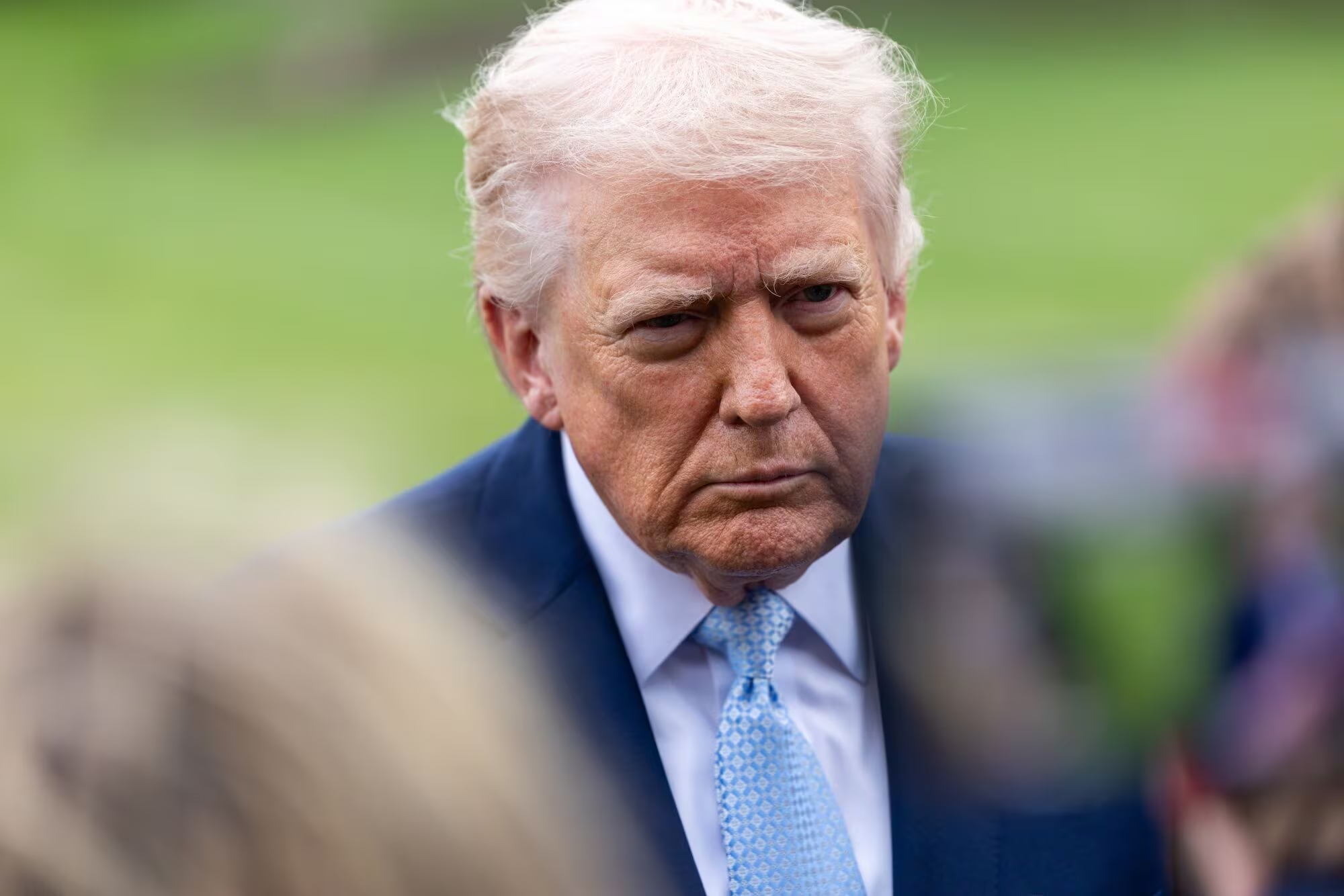
President Trump renewed his threats on Saturday, explicitly stating that Tehran has a narrow window to restore maritime traffic in the vital shipping lane. “Remember when I gave Iran ten days to MAKE A DEAL or OPEN UP THE HORMUZ STRAIT. Time is running out – 48 hours before all Hell will reign down on them,” the President wrote on social media. He added, “Glory be to GOD!”
The administration has specified April 6 as the firm deadline. While the President previously suggested the strait might open “naturally” after the conflict to allow Iran to sell oil and rebuild, his current tone has shifted toward immediate kinetic action. Senator Lindsey Graham, after speaking with the President, echoed this resolve. “I am completely convinced that he will use overwhelming military force against the regime if they continue to impede the Strait of Hormuz and refuse a diplomatic solution,” Graham stated.
Tehran Rejects Ultimatums as Retaliatory Threats Mount
Iran has responded to the White House with public defiance, rejecting recent ceasefire overtures and characterizing the 48-hour deadline as a provocation. Iranian officials warned that any strikes against their national infrastructure or power plants would trigger immediate retaliatory strikes. Tehran signaled that such a response would target U.S. assets and regional energy and desalination facilities. While Iran claims the Strait
remains open to neutral nations, it continues to restrict access to vessels from countries it deems hostile, further complicating international diplomatic efforts led by Oman and the United Kingdom.
The Search for the Fallen
Simultaneously, U.S. Central Command is conducting a “very dangerous and complex” search and rescue operation for a missing F-15E Strike Eagle crew member. The aircraft was downed over Iranian territory on Friday, marking one of at least seven manned U.S. aircraft lost during the war. While one crew member was successfully rescued and is in U.S. custody, the status of the second remains unknown. The air war intensified further as a U.S. A-10 Thunderbolt II was also struck yesterday, though the pilot successfully ejected in non-hostile territory and was rescued.
Special forces veterans warn that the mission is hindered by active pursuit from Iranian forces in mountainous terrain. Iranian state media has mocked the search efforts, with an anchor on Fars News stating that a reward is being offered for anyone capturing an “enemy pilot or pilots.” However, Tehran officials have officially denied that the service member is currently in their custody.
A Strategic Shift in Aerial Warfare
The downing of these aircraft marks the first time U.S. military jets have been lost to enemy fire in over 20 years. The last such loss occurred during the 2003 invasion of Iraq. Military analysts note that while the U.S. has maintained dominance in recent insurgent conflicts, Iran’s anti-aircraft capabilities present a more sophisticated challenge. Retired Air Force Brig. Gen. Houston Cantwell described the survival of U.S. jets until this point as an “absolute miracle,” noting that pilots face incoming fire daily. Despite President Trump’s assertions that Iran’s military is “completely decimated,” these losses suggest a regime that remains lethal even in a weakened state.
The Risks of Low-Altitude Combat
Experts suggest the F-15 was likely targeted by portable, shoulder-fired missiles, which are notoriously difficult to detect. U.S. planes have recently been flying missions at lower altitudes, increasing their vulnerability to such surface-to-air threats. While the U.S. has flown over 13,000 missions and struck 12,300 targets, the political toll of these losses is significant. Analysts point out that the American public, accustomed to low-casualty wars, may find any loss of life unacceptable. Pilots remain trained for these high-threat environments, focusing on wound care and secure communication following violent ejections.
Erosion of Iran’s Industrial and Educational Base
The U.S. and Israel have significantly expanded their target list, moving beyond military installations to strike the heart of Iran’s economy. Saturday saw precision strikes on the Mahshahr and Bandar Imam petrochemical complexes. Israeli Prime Minister Benjamin Netanyahu claimed that strikes have already destroyed 70% of Iran’s steel production capacity.
The Bushehr nuclear power plant has also come under fire for the fourth time. Russian state-owned firm Rosatom confirmed the evacuation of nearly 200 staff members after a projectile struck the facility’s perimeter, killing one security guard. Beyond industrial sites, Iranian Science Minister Hossein Simaei Sarraf reported that over 30 universities have faced “direct attacks,” including the prestigious Shahid Beheshti University in Tehran.
Economic and Regional Human Toll
The effective closure of a waterway that handles 20% of the world’s oil has triggered a domestic price shock. According to AAA, average U.S. gas prices have climbed to $4.10 a gallon, a 37% increase since the war began on February 28. In California, prices have surged to nearly $5.92.
The humanitarian cost continues to mount across the region. In Lebanon, the health ministry reported that over 1,400 people have been killed since March 2. In Iran, the Red Crescent reports over 2,000 fatalities, including more than 200 children. The conflict is also bleeding across borders, with a deadly airstrike at the Shalamcheh crossing on the Iraq-Iran border killing one Iraqi civilian. The Iranian Red Crescent confirmed the death of a fourth aid worker, prompting the IFRC to remind combatants that “the safety of those protecting and assisting others must be ensured.”
Regional Spillover and Peacekeeping Risks
The geographic scope of the violence is expanding beyond the primary combatants. Indonesia expressed “grave concern” after three of its peacekeepers were injured in southern Lebanon while serving with the United Nations Interim Force in Lebanon (UNIFIL). These developments coincide with reports of intercepted Iranian cluster munitions landing near Israeli military headquarters in Tel Aviv, illustrating the lack of safe zones in the escalating theater.
Domestic Hardline Policies
As the war intensifies abroad, the Trump administration is tightening security at home. Secretary of State Marco Rubio announced the arrest and pending deportation of Hamideh Soleimani Afshar—the niece of the late IRGC commander Qasem Soleimani—along with her daughter. The State Department alleged Afshar “promoted Iranian regime propaganda” while living in Los Angeles. Rubio stated, “The Trump Administration will not allow our country to become a home for foreign nationals who support anti-American terrorist regimes.”
Diplomatic Fragmentation
While Iran has signaled it might allow vessels carrying “essential goods” to pass, it has not defined those terms or clarified if “hostile nations” remain barred. Meanwhile, a patchwork of global shipping continues; Chinese, Turkish, and Japanese vessels have reportedly used a “transit detour.” A scheduled UN Security Council vote to secure safe passage remains postponed as the 48-hour clock continues to tick.
The international community remains caught between the rapid degradation of Iranian infrastructure and the looming threat of a total maritime blockade. As the Monday deadline approaches, the global economy sits in a state of suspended animation, awaiting either a breakthrough in back-channel diplomacy or the onset of “all Hell” promised by the United States of America.


