
By Nana Karikari, Senior Global Affairs Correspondent
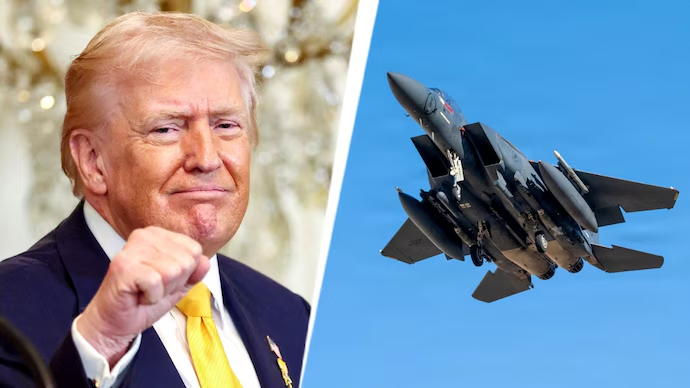
A missing service member whose F-15 jet was shot down over Iran is now “SAFE and SOUND” after a United States forces rescue operation involving “dozens of aircraft,” President Donald Trump said early Sunday. The high-stakes extraction from the Iranian highlands concludes a frantic search-and-rescue mission that has transfixed global leadership.
Trump identified the rescued aviator as a “highly respected Colonel” and “Brave Warrior,” marking a significant tactical victory for Washington after Tehran had reportedly promised a bounty for the capture of any “enemy pilot.” “WE GOT HIM!” President Trump announced in a Truth Social post just after midnight on Easter Sunday.
The President revealed that the administration had initially withheld confirmation of a first crew member’s earlier rescue to avoid jeopardizing this second, more complex operation. He noted the Colonel had been “behind enemy lines… being hunted down by our enemies, who were getting closer and closer by the hour.”
The rescue comes at a moment of extreme geopolitical friction, as President Trump simultaneously escalated pressure on Tehran. He issued a final 48-hour warning on Saturday for Iran to reopen the Strait of Hormuz by Monday or face “all Hell.”
Details of the Daring Mission
The rescue operation, which Trump described as “one of the most daring in U.S. history,” involved dozens of aircraft armed with lethal weaponry and continuous surveillance. Military officials reportedly established early communications with the Colonel at noon Eastern Time on Friday. Despite being injured in the ejection, the
officer utilized specific signaling techniques to avoid detection while evading capture in the treacherous terrain.
The mission faced significant local resistance; state media reported that Iranian tribesmen in the Bakhtiari region and Kohgiluyeh and Boyer-Ahmad province used rifles to shoot at U.S. helicopters. Experts suggest the rescue helicopters faced extreme risks, as “low and slow” flight paths are highly susceptible to ground fire.
The Colonel has now begun a formal reintegration and medical debriefing process. While he sustained injuries during the ordeal, the President assured the public that the officer “will be just fine.”
A Rare Breach of Air Supremacy
The loss of the F-15E and the reported crash of an A-10 Warthog mark the first time a U.S. warplane has been shot down by enemy fire in over 20 years. The last such incident occurred in 2003 during the invasion of Iraq. Analysts suggest that while the U.S. maintains air superiority, it has yet to achieve absolute air supremacy. “A disabled air defense system is not a destroyed one,” noted Behnam Ben Taleblu of the Foundation for Defense of Democracies, emphasizing that Iran remains “weak but still lethal.”
Defense experts believe the aircraft were likely targeted by portable, shoulder-fired missiles. These weapons are difficult to detect and suggest that Iranian forces are utilizing asymmetrical tactics as the regime “fights for its life.” Despite these losses, military advisors maintain the air war has been a tactical success, noting that the U.S. has struck over 12,300 targets across 13,000 missions since the conflict began.
Drones Hit Gulf Energy Infrastructure
Regional infrastructure has suffered heavily as the conflict expands. In Kuwait, an Iranian drone attack caused significant damage to two power plants and put a water desalination station out of service. In Bahrain, the national oil company reported a drone strike ignited a fire at a storage facility.
In the United Arab Emirates, authorities responded to multiple fires at the Borouge petrochemicals plant in Ruwais. Production halted after falling debris from successful interceptions struck the facility. These strikes followed an Israeli attack on an Iranian petrochemical plant that Prime Minister Benjamin Netanyahu said “generated revenue” used to fund the war.
Escalating Air War and Regional Damage
The F-15E marked the first time Iranian forces successfully shot down a U.S. combat aircraft since the war began on Feb. 28. While the U.S. has flown over 10,000 missions, The Wall Street Journal and The Washington Post reported that a U.S. A-10 Warthog also crashed in Kuwait after being hit by Iranian fire. Additionally, a U.S. F-35 was forced into an emergency landing last month after taking fire. These incidents highlight the “ability of a degraded Iranian military to continue to hit back” despite U.S. claims that the nation had been “decimated.”
Economic Shockwaves and the Hormuz Deadline
The conflict has sent global energy markets into high volatility. According to S&P Global, the spot price for Brent crude oil soared to $141.36 (approx. GH₵ 1,556) on Thursday—the highest level since the 2008 financial crisis. This was $32.33 (approx. GH₵ 356) higher than the Brent crude futures contract for June delivery, which closed at $109.03 (approx. GH₵ 1,200).
President Trump issued a final warning for Iran to reopen the Strait of Hormuz by Monday. “Remember when I gave Iran ten days to MAKE A DEAL or OPEN UP THE HORMUZ STRAIT. Time is running out — 48 hours before all Hell will reign down on them,” the President Trump said Saturday in a Truth Social post.
Diplomatic Efforts Amid Threats of Total War
Despite the aggressive rhetoric, a diplomatic track remains active in Islamabad. Tahir Andrabi, a spokesperson for Pakistan’s Foreign Ministry, stated that efforts to broker a ceasefire are “right on track.” Mediators from Pakistan, Turkey, and Egypt are working to bring the U.S. and Iran to the negotiating table.
Military leaders in Tehran remain defiant. “The doors of hell will be opened to you” if Iran’s infrastructure is attacked, General Ali Abdollahi Aliabadi warned. Meanwhile, Trump told Americans in a televised address on Wednesday that he expects the war to last another two to three weeks, asserting, “We are going to finish the job, and we’re going to finish it very fast.”
The Human Toll and Precarious Path Forward
The war has killed thousands since February 28, bringing “warnings of possible war crimes.” More than 1,900 people have been killed in Iran. Lebanon has seen over 1,400 deaths and the displacement of more than one million citizens. Casualty reports include 19 dead in Israel and 10 Israeli soldiers killed in Lebanon.
Thirteen U.S. service members have died so far. While the safe recovery of a senior officer provides a domestic victory, it does little to dampen regional volatility. Critically, the world watches to see if the weight of human and economic cost will force a pivot toward the negotiating table, or if the momentum of retaliation has become irreversible.


