
By Nana Karikari, Senior Global Affairs Correspondent
Key highlights include:
- Military Escalation: Coverage of the “next phase” of operations and the deployment of new CENTCOM capabilities.
- Regional Impact: Analysis of Saudi and Gulf state defense interceptions and the targeting of US-made radar systems.
- Geopolitical Friction: Inclusion of the “surprises” promised by the IDF, the failure of war power curbs in Washington, and direct quotes from President Trump regarding Iranian succession.
- African Perspective: Crucial context on the diplomatic and economic responses from Ghana and the African Union, including the impact on shipping and fuel prices.
Military operations across the Middle East entered a volatile new phase on Friday as the conflict between the United States, Israel, and Iran reached its seventh day. While Iranian missile launches have seen a sharp decline, the Trump administration has ramped up its offensive, striking key infrastructure in Tehran and Beirut. The White House has warned that the war will soon escalate further, while NATO allies find themselves reluctantly pulled into the theater of operations.
Main headlines
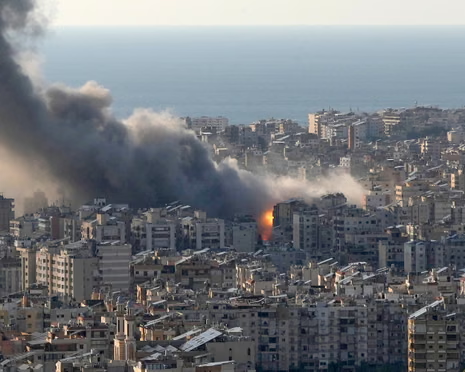
The United States and Israel intensified their joint aerial campaign overnight, with explosions echoing across Tehran and Beirut early Friday. CENTCOM confirmed the US military is now employing “a number of new capabilities” in the field. Defense Secretary Pete Hegseth issued a stern warning regarding the expanded operations, stating: “If you think you’ve seen something, just wait.” Hegseth further defended the aggression in a press briefing, characterizing the offensive by saying: “This was never meant to be a fair fight, and it is not a fair fight. We are punching them while they’re down, which is exactly how it should be.”
Despite the American escalation, Iranian strike activity has dropped significantly. US Central Command reported Thursday that Iranian ballistic missile attacks decreased by 90% and drone strikes by 83%. This shift has provided brief relief to neighboring Gulf states that previously bore the brunt of Tehran’s retaliation. However, US naval forces have not relented, reportedly sinking the Iranian warship IRIS Dena off the coast of Sri Lanka and striking a drone carrier ship in the Gulf.
European powers including Britain, France, and Spain have agreed to provide military support to protect allied interests, though internal criticism remains. While Italy sent defensive weapons to the Persian Gulf, its defense minister argued the US-Israel attack on Iran had violated international law. Meanwhile, NATO states have heightened their defense posture after a suspected Iranian missile was intercepted heading toward Turkish airspace on Wednesday. Iran denied firing any missiles toward Turkey, according to state media.
Events in Iran and Lebanon
The Israeli military is moving to the “next phase” of the war. The IDF military chief announced late Thursday that forces would push deeper into Lebanon following 2,500 strikes involving more than 6,000 weapons. Early Friday, Israel launched a “broad-scale wave of strikes” targeting key regime infrastructure in Tehran. Israel has also hinted at unnamed “surprises” ahead after claiming to have degraded most of Iran’s air defenses.
Beirut remains a primary target, specifically the southern suburbs identified as a stronghold of the Iran-backed group Hezbollah. Evacuation orders issued Thursday covered neighborhoods housing over 500,000 people, causing mass panic. The human cost continues to rise, with state media reporting more than 1,200 deaths in Iran and over 120 in Lebanon. Iranian strikes have also killed dozens in other countries across the region. Reports also indicate heavy civilian casualties within Iran, including over 160 deaths at an elementary school in Pakdasht.
Developments across the region
Conflict continues to ripple through neighboring nations. Iran claimed it launched a hybrid drone and missile attack at Tel Aviv on Thursday night. Observers reported seeing what appeared to be a cluster warhead in the skies over central Israel.
In the Gulf, Saudi Arabia’s Defense Ministry reported multiple intercepts. Officials said three drones were destroyed in eastern areas of Riyadh, while another drone was neutralized to the northeast of the capital. Air defenses also intercepted a cruise missile over the city of Kharj and three ballistic missiles targeting a base south of Riyadh the previous night. In Bahrain, a hotel, two residential buildings, and an oil refinery were struck.
Satellite imagery suggests Iran is specifically targeting US-made radars to weaken THAAD air defense systems. The conflict has also expanded toward the Caucasus, with Iran accused of striking Azerbaijan—a claim Tehran denies. The regional chaos has grounded over 11,000 flights, according to Flightradar24, while the first chartered evacuation flight carrying Americans departed Abu Dhabi on Thursday.
The latest from Washington
Political tension is mounting in the United States as the House failed to pass a measure to curb President Donald Trump’s war powers on Thursday. The 212-219 vote followed a similar failure in the Senate. The narrow margin signals growing congressional unease as US priorities are reordered.
Diplomatic operations have been severely impacted. The US Embassy in Kuwait has closed following retaliatory strikes and the death of six American soldiers in a drone attack on Sunday.
President Trump has expressed a direct interest in the future of Iranian governance. He told Axios he must be “involved in the appointment” of the next supreme leader. Trump dismissed Mojtaba Khamenei, the son of the late leader, as “unacceptable” and a “lightweight.” Despite the diplomatic friction, Defense Secretary Hegseth has not ruled out the possibility of a ground invasion. Meanwhile, Iranian state media reports that a leadership council, including President Masoud Pezeshkian, has convened to discuss the selection of a successor to the late Ayatollah Ali Khamenei.
Global powers respond
The international community has reacted with sharp condemnation and calls for restraint. The Kremlin labeled the strikes “unprovoked acts of armed aggression” and a “cynical” breach of international norms, though Moscow confirmed Thursday that Iran has not requested direct military support. China has also entered the diplomatic fray, with Foreign Minister Wang Yi stating that “force cannot truly solve problems—instead, it will only bring new problems.” Beijing announced it will dispatch special envoy Zhai Jun to the region to work for de-escalation, even as it continues the evacuation of over 3,000 Chinese citizens from Iran.
Africa on alert
Across the African continent, governments have moved from concern to active crisis management. Accra has activated an emergency preparedness plan, with Ghana’s government suspending non-essential travel to Israel, Kuwait, and the UAE, while beginning the departure of diplomatic families from Tehran. African Union Commission Chairperson Mahmoud Ali Youssouf warned that the escalation threatens to worsen global instability, with “serious implications for energy markets, food security, and economic resilience” in Africa.
The economic toll is already surfacing; global shipping diversions around the Cape of Good Hope have added up to fifteen days to transit times, significantly increasing freight costs for African importers. In South Africa and Kenya, officials warned of a “dangerous spike” in fuel prices at the pump, as oil markets react to the closure of the Strait of Hormuz. While leaders like Kenya’s William Ruto condemned Iranian retaliatory strikes as a threat to international security, South African President Cyril Ramaphosa challenged the legality of the initial US-Israeli strikes, emphasizing that “there can be no military solution to fundamentally political problems.”
The Path to Escalation
As the conflict enters its second week, all eyes remain on the potential for a ground incursion into Lebanon or Iran. Diplomatic sources suggest that while military activity from Tehran has slowed, the regional “theater of the absurd”—as described by some analysts—is far from over. UN officials are expected to convene an emergency session in Geneva later today to discuss humanitarian corridors, as the displacement of half a million people in Beirut creates a burgeoning refugee crisis that may soon ripple far beyond the borders of the Middle East.


