By Nana Karikari, Senior Global Affairs Correspondent
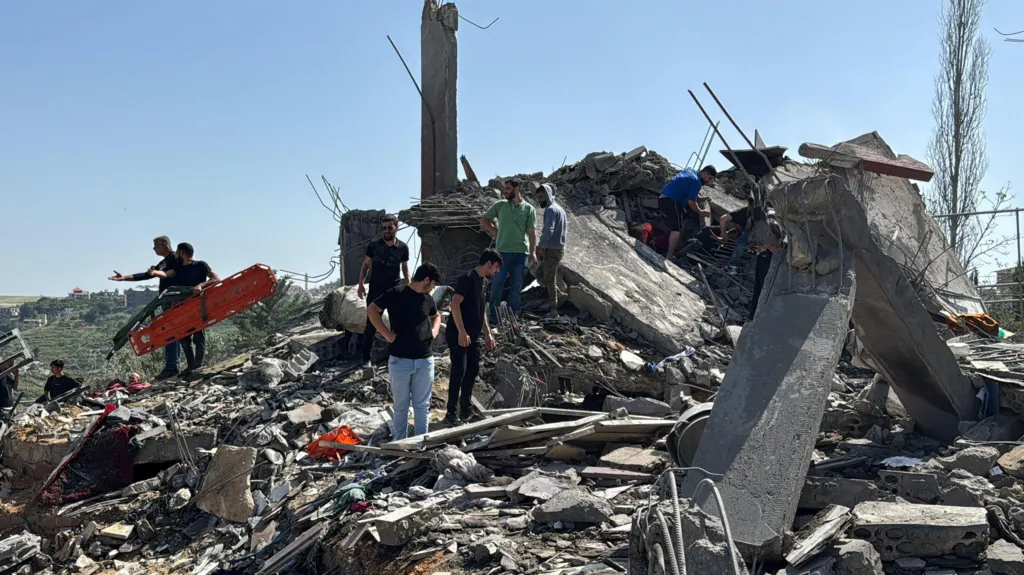
Intense Israeli airstrikes killed thirty-nine people across Lebanon on Saturday. The Lebanese health ministry confirmed the casualties amid a surge in regional violence. One strike targeted the southern town of Saksakiyeh. This attack killed at least seven people. A child was among the dead. The ministry noted that the raid “resulted in an initial toll of seven martyrs, including a girl, and 15 wounded, including three children.”
The Israel Defense Forces stated they targeted Hezbollah militants. Military officials claimed they were “aware of reports regarding harm to uninvolved civilians.” The IDF insisted they hit “Hezbollah terrorists operating from within a structure used for military purposes.” They added that “prior to the strike, steps were taken to mitigate the risk of harm to civilians as much as possible, including the use of precise munitions and aerial surveillance.” On Saturday, the IDF issued fresh evacuation orders for nine southern villages, citing “Hezbollah’s violation of the ceasefire agreement” as the catalyst for expanded operations.
Civilian Casualties Increase Amid Precision Claims
Lebanese officials reported another strike on a motorbike in Nabatieh. The attack hit “a Syrian national and his 12-year-old daughter.” According to the health ministry, the victims attempted to flee after an initial blast. “After they managed to move away from the site of the first strike, the drone attacked a second time,” the ministry stated. The drone then reportedly targeted the girl “directly for a third time.” She is currently undergoing life-saving surgery.
The scope of Saturday’s bombardment extended across the southern districts. Beyond Saksakiyeh, fatalities were reported in Nahrain, Saadiyat, Haboush, and Mefdoun. In Nabatieh’s al-Bayad neighborhood, an air raid on a building killed three young men, while a separate drone strike targeted a motorcycle near shops on the Toul–Doueir road. Since March 2, the death toll in Lebanon has reached 2,795 people. More than 120 people died in the last week alone. The Lebanese health ministry does not distinguish between combatants and civilians in its figures. The Israeli military currently occupies a 10km security zone in southern Lebanon, maintaining a buffer that prevents the return of hundreds of thousands of displaced residents.
Hezbollah Retaliates with Drone and Rocket Attacks
Hezbollah launched multiple drones and rockets into northern Israel on Saturday. The group claimed these actions were a response to continued Israeli aggression. One explosive drone wounded three Israeli army reservists. The IDF confirmed one soldier was seriously injured. Hezbollah reported nine total attacks against Israeli forces throughout the day.
Tactical engagements intensified in the border towns of Biyyada and Rachaf, where Hezbollah launched artillery shells at Israeli positions. The group also claimed to have disabled an Israeli D9 military bulldozer in al-Abbad. Both sides continue to accuse each other of violating the ceasefire agreement announced by the U.S. President Donald Trump on April 16. Since that truce was signed, nearly 500 people have been killed in Lebanon as the conflict enters its third week of a tenuous “halt” in fighting.
Regional Tensions Escalate Near the Strait of Hormuz
The conflict between Israel and Hezbollah coincides with rising friction between the United States and Iran. Tehran warned of a “heavy assault” against American assets if Iranian ships face further aggression. This follows a U.S. blockade in the Strait of Hormuz. The naval command of the Islamic Revolutionary Guard Corps stated that “any aggression” would result in a “heavy assault against one of the American centers in the region.”
The IRGC Aerospace Force command added that “missiles and drones are locked onto the enemy.” They cautioned that they are “awaiting the order to fire.” These threats follow an incident where a U.S. fighter jet disabled two Iranian tankers. The blockade has already severely disrupted Iranian energy domestic supplies, prompting Tehran to urge citizens to ration electricity and gas. Meanwhile, the United Kingdom is deploying the HMS Dragon to the region to support mine clearance and protect shipping interests as part of a “strictly defensive” plan.
Economic Fallout and Stalled Peace Negotiations
The persistent fighting has triggered significant economic distress globally. Food prices rose for a third consecutive month in April. Fertilizer costs have spiked due to the Middle East conflict. In the United States, gas prices remain over a dollar higher than last year. Economists observe that households are cutting savings to manage these rising costs.
Diplomatic efforts remain in a state of limbo, even as the U.S. announced it would mediate a second round of negotiations in Washington, D.C., scheduled for May 14 and 15. The U.S. Department of State said the talks aim to advance “a comprehensive peace and security agreement that substantively addresses the core concerns of both countries.” Despite the violence, President Trump maintains that the ceasefire agreement is holding. In Beirut, President Joseph Aoun met with former Ambassador Simon Karam, who will lead the Lebanese delegation, to provide “directives ahead of his trip to Washington.”
The widening gulf between diplomatic rhetoric and the reality on the ground suggests a precarious future for the April 16 truce. While world leaders emphasize the framework of a ceasefire, the escalating body count in Lebanon and the naval standoff in the Strait of Hormuz indicate that a definitive end to the hostilities remains elusive. For the civilians caught in the crossfire and the global markets reacting to the instability, the path toward a permanent resolution remains fraught with significant military and political obstacles