By Nana Karikari, Senior Global Affairs Correspondent
United States President Donald Trump intensified his rhetoric against Iran on Sunday, promising a devastating military campaign if the Strait of Hormuz is not reopened to international traffic by Tuesday.
The President issued a series of blunt warnings via social media, specifically targeting Iran’s power grid and transportation networks. The ultimatum marks a sharp escalation in a conflict that has now entered its second month, with the global economy feeling the strain of disrupted energy corridors.
“Tuesday will be Power Plant Day, and Bridge Day, all wrapped up in one, in Iran. There will be nothing like it!!!” Trump stated in a Truth Social post. The President characterized the Iranian leadership as “crazy bastards” and vowed they would be “living in Hell” should the deadline pass without compliance.
Humanitarian Concerns and Domestic Criticism
The President’s plan to target civilian infrastructure has drawn immediate fire from legal experts and political opponents. International humanitarian law generally prohibits the destruction of facilities essential to the civilian population, and critics warn such strikes could be classified as war crimes.
Senator Tim Kaine, D-Va., lambasted the administration’s approach during an appearance on reporters’ programs. Kaine, a member of the Senate Armed Services Committee, described the President’s rhetoric as “embarrassing and juvenile.” He
argued that such aggressive posturing endangers American service members who may be captured in the future.
“If you send the message that there’s no quarter for the folks on the other side, that really encourages them to mistreat our folks,” Kaine said. He further criticized the White House for what he described as “the absence of a plan, the absence of a clear rationale, no effort to get allies on board.”
Military Rescue and Conflicting Accounts
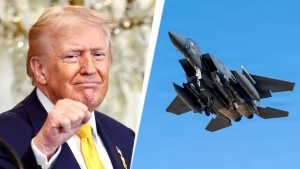
The diplomatic heat coincides with high-stakes military operations. President Trump confirmed Sunday that the United States successfully rescued a “highly respected Colonel” who had been missing since his F-15E Strike Eagle was downed over Iran last week. The President hailed the mission as “one of the most daring Search and Rescue Operations in U.S. History.”
While the U.S. celebrated the recovery of the “seriously wounded” officer, Tehran offered a different narrative. Iranian state television broadcast images of wreckage, claiming they shot down a transport plane and two helicopters during the rescue. Separately, U.S. officials confirmed the pilot of an A-10 Warthog was forced to eject over Kuwait after being hit by Iranian fire.
Iran’s military joint command countered by claiming four U.S. aircraft were destroyed during the rescue operation. A spokesman warned via IRNA news agency: “If you commit aggression again and strike civilian facilities, our responses will be more forceful.”
A regional intelligence official, speaking to the media on condition of anonymity, contradicted Tehran’s claims regarding the rescue mission. The official stated the U.S. military intentionally blew up two of its own transport planes due to technical malfunctions to protect sensitive technology.
Regional Instability and Energy Shockwaves
The conflict is no longer confined to U.S.-Iranian exchanges. Iran has expanded retaliatory strikes to Gulf Arab states hosting U.S. military installations. On Saturday, a projectile struck an auxiliary building near Iran’s Bushehr nuclear plant, killing one person, though operations were unaffected. Subsequently, Russia’s Rosatom evacuated 198 staff members from the site.
On Sunday, Iranian drone attacks targeted petrochemical plants and power facilities in Kuwait, Bahrain, and the United Arab Emirates. The disruption has sent shockwaves
through energy markets. The spot price for current physical cargoes of Brent crude oil soared Thursday to $141.36 (approx. GH¢1,556.37), the highest level since the 2008 financial crisis.
The spot price reflects demand for Brent oil to be delivered in the next 10 to 30 days. The high price of immediate oil deliveries points to current physical supply constraints due to the huge disruption triggered by Iran’s closure of the Strait of Hormuz. The price was $32.33 (approx. GH¢355.95) higher than the Brent crude futures contract for June delivery, which closed at $109.03 (approx. GH¢1,200.42) on Thursday.
Impact on Ghana and the African Continent
The escalating tension in the Middle East has triggered immediate economic repercussions across Africa. In Ghana, the National Petroleum Authority (NPA) recently reported a surge in fuel prices, with petrol rising to GH¢13.30 per litre and diesel to GH¢17.10 per litre. Experts warn that a prolonged blockade of the Strait of Hormuz could increase Ghana’s annual oil import bill by $2.4 billion (approx. GH¢26.42 billion), potentially reversing recent gains in inflation management. The African Union (AU) has called for “urgent de-escalation,” warning that the conflict threatens food security and economic resilience across the continent, as 20% of the world’s oil supply remains at risk.
Diplomatic Channels and the Path to Tuesday
Despite the looming deadline, some diplomatic threads remain active. Oman’s foreign ministry reported meeting with Iranian officials to discuss visions for ensuring transit. “During the meeting, experts from both sides presented a number of visions and proposals that will be studied,” the Omani statement on X read.
Concurrently, Iran’s foreign minister has, in principle, left the door open for peace talks with the U.S. amid ongoing mediation from Pakistan. Foreign Minister Abbas Araghchi expressed gratitude for the efforts in Islamabad but gave no indication of Tehran’s willingness to bow to Trump’s specific demands. “We are deeply grateful to Pakistan for its efforts and have never refused to go to Islamabad. What we care about are the terms of a conclusive and lasting END to the illegal war that is imposed on us,” Araghchi said on X. In a supporting statement on Saturday, Pakistani officials told the media that efforts to broker a ceasefire are “right on track.”
Closing the Window for Negotiation
The window for these diplomatic efforts is rapidly closing. On March 26, President Trump extended a pause in attacking Iran’s energy facilities by 10 days to April 6 at the request of the Islamic Republic’s government. In a televised address from the White House on Wednesday, the President told Americans he expects the war to last another two to three weeks but insisted the conflict was nearing its conclusion. “We are going to finish the job, and we’re going to finish it very fast,” he said.
With the 48-hour countdown under way, the President’s patience appears to have reached its limit. “Remember when I gave Iran ten days to MAKE A DEAL or OPEN UP THE HORMUZ STRAIT. Time is running out – 48 hours before all Hell will reign [sic] down on them,” Trump warned Saturday in a Truth Social post. He is scheduled to speak from the Oval Office on Monday at 1 p.m. ET (5 p.m. GMT).
As the deadline approaches, the international community remains caught between the White House’s demand for an immediate reopening of the Strait and Tehran’s insistence on ending what it terms an “illegal war.” With global markets and regional stability hanging in the balance, the coming 48 hours represent a critical juncture that will determine if diplomacy can still avert a total regional conflagration.