
By Nana Karikari, Senior Global Affairs Correspondent
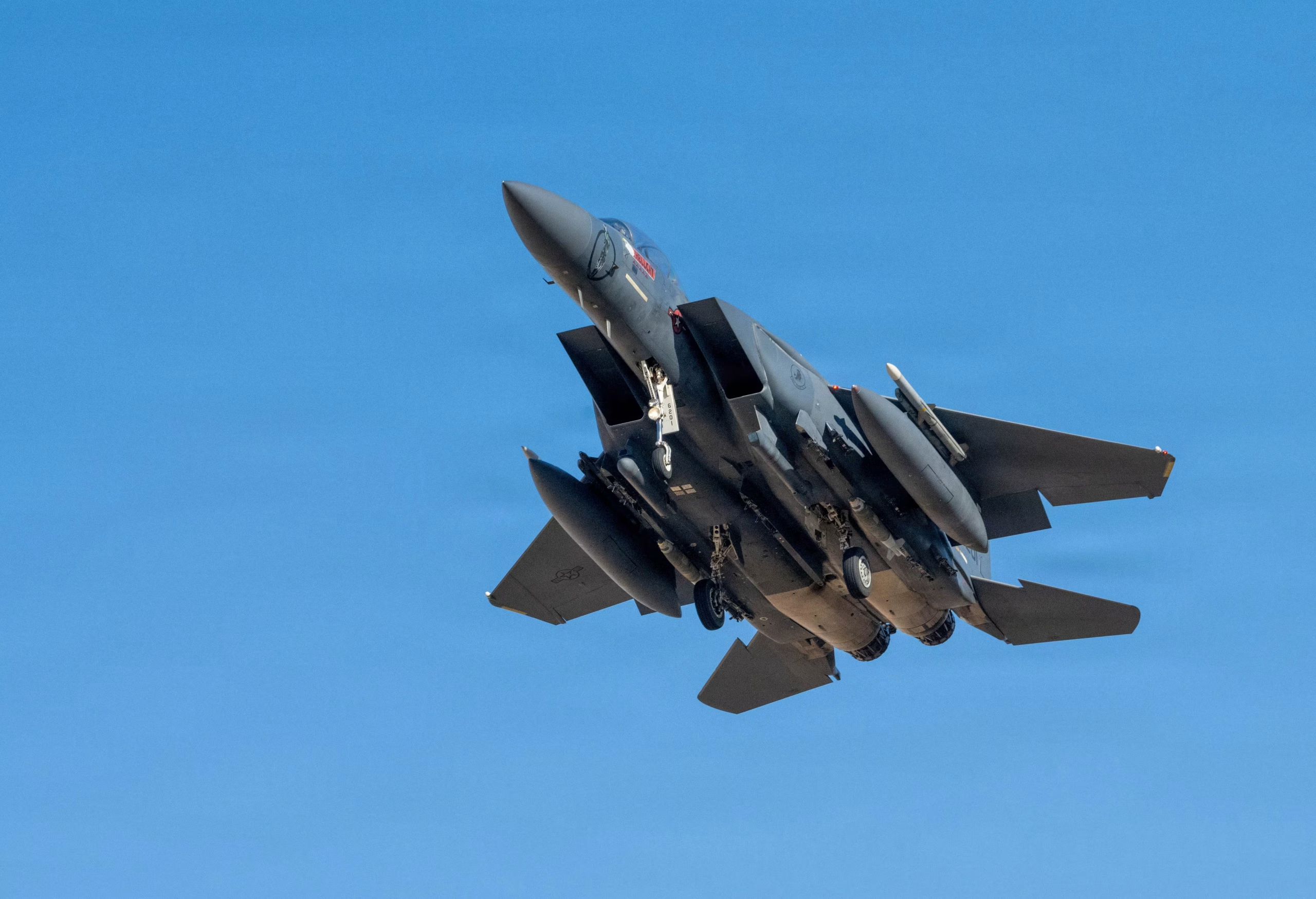
The United States military expanded search and rescue operations Saturday following the downing of an American warplane over Iranian territory. This incident marks the first loss of U.S. aircraft within Iran since the conflict began six weeks ago. Iranian authorities identified the downed craft as an F-15E Strike Eagle and have publicly called for citizens to locate the “enemy pilot” in exchange for a reward. “If you capture and hand over a pilot or pilots of the enemy alive… you will receive a valuable reward and prize,” an Iranian news anchor announced. Videos emerged Saturday appearing to show Iranian police in the town of Charam firing at specialized Black Hawk helicopters participating in the recovery effort.
Discrepancies in Aircraft Status and Casualties
Pentagon officials confirmed that one crew member was successfully rescued following the Friday engagement. However, the status of a second service member remains unknown. Military analysts note that crews are extensively trained in “SERE” (Survival, Evasion, Resistance, and Escape) protocols to lower their profile in hostile terrain. While Iran claimed a second aircraft crashed in the Persian Gulf, U.S. officials clarified that an A-10 Thunderbolt II was indeed struck on Friday. The pilot successfully navigated the “Warthog” out of Iranian airspace before ejecting and was subsequently rescued. These two incidents bring the total number of manned U.S. aircraft lost during this conflict to at least seven.
Rhetoric Meets Reality on the Battlefield
The loss of aviation assets occurred only two days after President Donald Trump delivered a national address claiming victory. During that speech, the President asserted that the U.S. had “beaten and completely decimated Iran” and promised to “finish the job, and we’re going to finish it very fast.” Brigadier General Alireza Elhami, commander of Iran’s Joint Air Defense Base, countered that the downing was the result of “innovations” in air defense that have caused “confusion and bewilderment for the enemy.” Democratic Rep. Seth Moulton criticized the President’s earlier claims, stating the Commander-in-Chief “doesn’t know what he’s talking about.”
Escalation Against Academic and Nuclear Sites
The conflict reached new levels of intensity as the Atomic Energy Organization of Iran reported an airstrike near the Bushehr nuclear facility. Simultaneously, U.S.-Israeli strikes hit the prestigious Shahid Beheshti University in Tehran. A separate strike reportedly “wiped out” a popular music school in Tehran that had served as a community haven. Separately, a missile strike in a residential area of North Tehran killed at least one person and gutted buildings. In a separate retaliatory wave, Iranian fire targeted Kuwait’s Mina al-Ahmadi oil refinery, while the Israel Defense Forces reported search and rescue teams were responding to “reports of impact” at sites in central Israel.
Retaliation Targets American Tech Giants in Dubai
Regional instability spread to the United Arab Emirates as an Iranian drone struck the Dubai headquarters of Oracle. The Revolutionary Guard had previously named Oracle as one of 17 U.S. tech targets, noting that co-founder Larry Ellison is an ally of President Trump. While the Dubai Media Office described the event as a minor incident, falling debris from intercepted attacks also caused two fires at Abu Dhabi gas facilities, resulting in at least one fatality.
Economic Toll and New Maritime Threats
Iran continues to maintain a strategic grip on the Strait of Hormuz, causing severe disruptions to global markets. The disruption has reduced global oil and gas supply by approximately one-fifth, triggering an “everything crisis” as prices for petrochemical derivatives like plastic, rubber, and polyester soar. Global food prices rose 2.4% in March alone due to energy costs. Iranian Parliament Speaker Mohammad Bagher Ghalibaf issued a veiled threat Saturday against the Bab el-Mandeb Strait. Meanwhile, the UN Security Council has postponed a vote on a Bahraini resolution to secure the Strait of Hormuz until next week. Diplomats cite resistance from China and Russia, with Beijing’s envoy warning that the resolution could “legitimize the unlawful use of force.”
Human Cost and Internal Dissent
The war has claimed thousands of lives across multiple borders since Feb. 28. Indonesia expressed “grave concern” after three of its peacekeepers serving with UNIFIL were injured in southern Lebanon, marking the third such incident in a week. While President Trump has threatened “much more to follow,” domestic opposition is growing. Republican Senator John Curtis announced he cannot support further funding for military operations without a formal declaration of war from Congress.
Fiscal Implications and Leadership Shakeups
President Trump is asking Congress for a historic $1.5 trillion for defense, a 40% increase intended to build the “Golden Dome” missile defense system. This request follows a string of recent losses, including three F-15s lost to “friendly fire” on March 2 and a KC-135 tanker crash on March 12. Amidst the war effort, internal turmoil hit the Pentagon as Defense Secretary Pete Hegseth abruptly fired Army Chief of Staff Gen. Randy George. Sources indicate the two were at loggerheads over personnel management and Hegseth’s alleged sidelining of officers—including female and Black officers—for political reasons.
Divergence Among Allies
Italian Prime Minister Giorgia Meloni publicly disagreed with President Trump’s criticism of European allies, stating her priority is defending national interests. This rift follows Italy’s recent move to block a U.S. aircraft from using a military base in Sicily. Despite these tensions, NATO Secretary General Mark Rutte is scheduled to meet with Trump Wednesday to discuss the alliance’s role in the conflict.
The downing of American aircraft and the subsequent “enemy pilot” hunt represent a significant shift in the war’s friction, moving the conflict from a distance-based air campaign to a direct confrontation on Iranian soil. As both sides target critical infrastructure—ranging from research universities to desalination plants—the window for a diplomatic resolution appears to be closing in favor of a broader regional escalation that tests the limits of both military technology and international alliances.


